Brisbane isn’t one climate – it’s several. Drive from Kenmore to Manly on a summer afternoon, and you’ll notice the difference. The western hills trap heat and funnel afternoon storms. The river corridor creates its own humidity pocket. Bayside suburbs deal with salt air, consistent sea breezes and a UV exposure that’s relentless. Each of these microclimates has real implications for how you design an outdoor space – and particularly how you approach pool design.
Getting this right means your pool stays comfortable to use when conditions are at their worst, your materials hold up over time, and your outdoor living area works with the environment rather than fighting it. Getting it wrong is an expensive lesson in local geography.

What Is a Microclimate and Why Does Brisbane Have So Many?
A microclimate is a localised set of atmospheric conditions that differs from the surrounding region. Brisbane’s topography – hills to the west and south, a major river winding through the middle, Moreton Bay to the east – creates a range of distinct conditions across a relatively compact urban area.
The dividing range suburbs (The Gap, Ferny Grove, Samford Valley) experience higher rainfall, cooler temperatures and afternoon storm activity that’s more intense than inner or eastern suburbs. The Brisbane River creates humidity corridors along its banks from Ipswich through to Hamilton and beyond. Bayside suburbs from Redcliffe down through Manly, Wynnum and Cleveland sit in near-constant coastal influence – wind, salt, moisture and a different seasonal rhythm to their western counterparts.
Understanding which microclimate your property sits in shapes every meaningful design decision, from the pool type and finish to the materials used for surrounding surfaces, fencing and landscaping.
Designing for the Hills: Western and Southern Brisbane Suburbs
Suburbs including The Gap, Kenmore, Chapel Hill, Pullenvale, Brookfield, Samford and the Toowong ridge all share characteristics that make pool and outdoor design distinctly different from lower-lying areas.
Heat retention and afternoon storms are the defining features. These suburbs receive more intense afternoon sun exposure on western and north-western aspects, and summer thunderstorms arrive faster and with more force than they do closer to the bay. A well-designed outdoor space accounts for both by prioritising shade structures, carefully considered pool orientation and drainage that can handle heavy, rapid rainfall.
For pools on steep sites, the hills present obvious construction challenges – retaining walls, excavation into clay and rock, and managing site drainage – but they also create genuine design opportunities. Elevated sites in these suburbs often deliver elevated views, and a well-positioned infinity pool can take full advantage of that. The vanishing edge creates a visual connection with the surrounding landscape that flat suburban blocks simply can’t replicate. This pool at Samford is the perfect example of this.
Concrete pools are particularly well-suited to challenging hill sites because they’re built to the shape of the site rather than dropped into it. A free-form pool design that follows the natural contour of a sloped block integrates more naturally than a rectangular form that requires significant earthworks to accommodate.
For pool tiles and surrounding surfaces in hill suburbs, thermal performance matters. Dark-coloured materials on pool surrounds absorb and retain heat – fine in winter, uncomfortable underfoot in a January afternoon storm aftermath when surfaces have spent the day in direct sun. Porcelain tiles with lighter colourways and good slip resistance are a practical choice for these conditions.

Designing for the River Corridor: Inner Brisbane and Surrounds
The suburbs running along both banks of the Brisbane River – from Graceville and Sherwood through West End, South Bank, New Farm and Teneriffe to Hamilton, Bulimba and Hawthorne – share a microclimate defined by humidity and a distinctive seasonal pattern.
River proximity amplifies humidity through Brisbane’s wet season. Warm, moist air sits in the valley created by the river corridor, and this has two significant effects on pool design. First, algae and biofilm growth is more vigorous in humid conditions, which influences how you approach pool chemistry and filtration. Second, timber and organic materials in outdoor spaces are under more persistent moisture stress, which affects material selection for decking, fencing and landscaping around the pool.
For chemical management in river corridor suburbs, a DHMO Systems automated monitoring setup is particularly valuable – the smart sensors track pH, chlorine and other parameters continuously, sending alerts when conditions drift. In a microclimate that accelerates chemical imbalance, having real-time data rather than relying on twice-weekly manual testing keeps you ahead of problems rather than reacting to them.
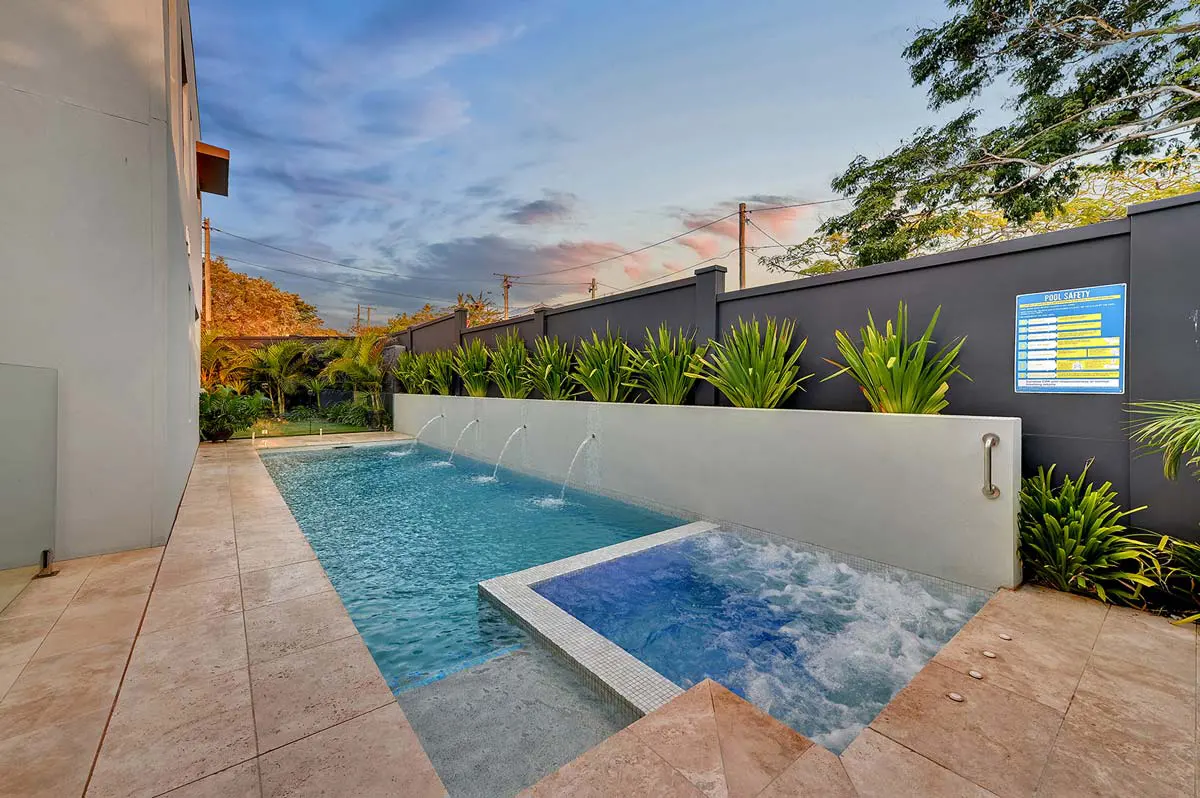
Many inner-Brisbane river corridor blocks are compact, which makes pool design for challenging sites relevant here too. Narrow blocks, tight access and neighbouring properties at close quarters require a design-led approach. Lap pools work particularly well in long, narrow inner-Brisbane yards, delivering genuine swimming functionality without needing significant width. A pool and spa combination also suits the inner-city lifestyle well – the spa provides year-round use even through Brisbane’s cooler months, and the combination can be designed compactly enough for tighter blocks. Take a look at this pool & spa combo pool on a narrow block in Yeronga.
Orientation is critical in the river corridor. Many riverside properties have their primary outdoor space on the eastern or southern side of the house, which affects afternoon sun access. A skilled design team will assess solar access carefully before recommending pool placement and surrounding landscape design.
Designing for Bayside: Redcliffe to Cleveland
The bayside suburbs – Redcliffe, Newport, Scarborough, Woody Point across the north, and Manly, Wynnum, Lota and Cleveland to the south – have a microclimate that’s genuinely different from the rest of Brisbane. Sea breezes are consistent. Salt air is pervasive. UV exposure is high. And the lifestyle orientation is unmistakably coastal.
Salt air is the defining design challenge in bayside suburbs. It accelerates corrosion on metals, degrades certain sealants faster than expected and affects material longevity across the outdoor space. Pool fencing material selection is particularly important – frameless glass with marine-grade stainless steel fittings handles salt air far better than powder-coated aluminium systems, which can show signs of corrosion within a few years in heavy salt exposure zones. Aluminium pool coping and surrounding metalwork should be marine-grade or stainless at minimum.
For pool finishes, pebble crete and quality pool tiles both perform well in coastal conditions, but grout and sealant selection needs to account for the salt environment. A pool builder who understands bayside conditions will specify differently here than they would for a western suburbs build.
The consistent sea breeze in bayside suburbs is an asset for outdoor comfort – these suburbs are genuinely more liveable through Brisbane summers than heat-trapped western hill areas – but it also means evaporation rates from the pool are higher, which affects water chemistry maintenance and running costs. Wind direction and strength should inform where you position a pool on the block, whether you incorporate wind breaks in the surrounding landscape and how you orient outdoor entertaining areas.
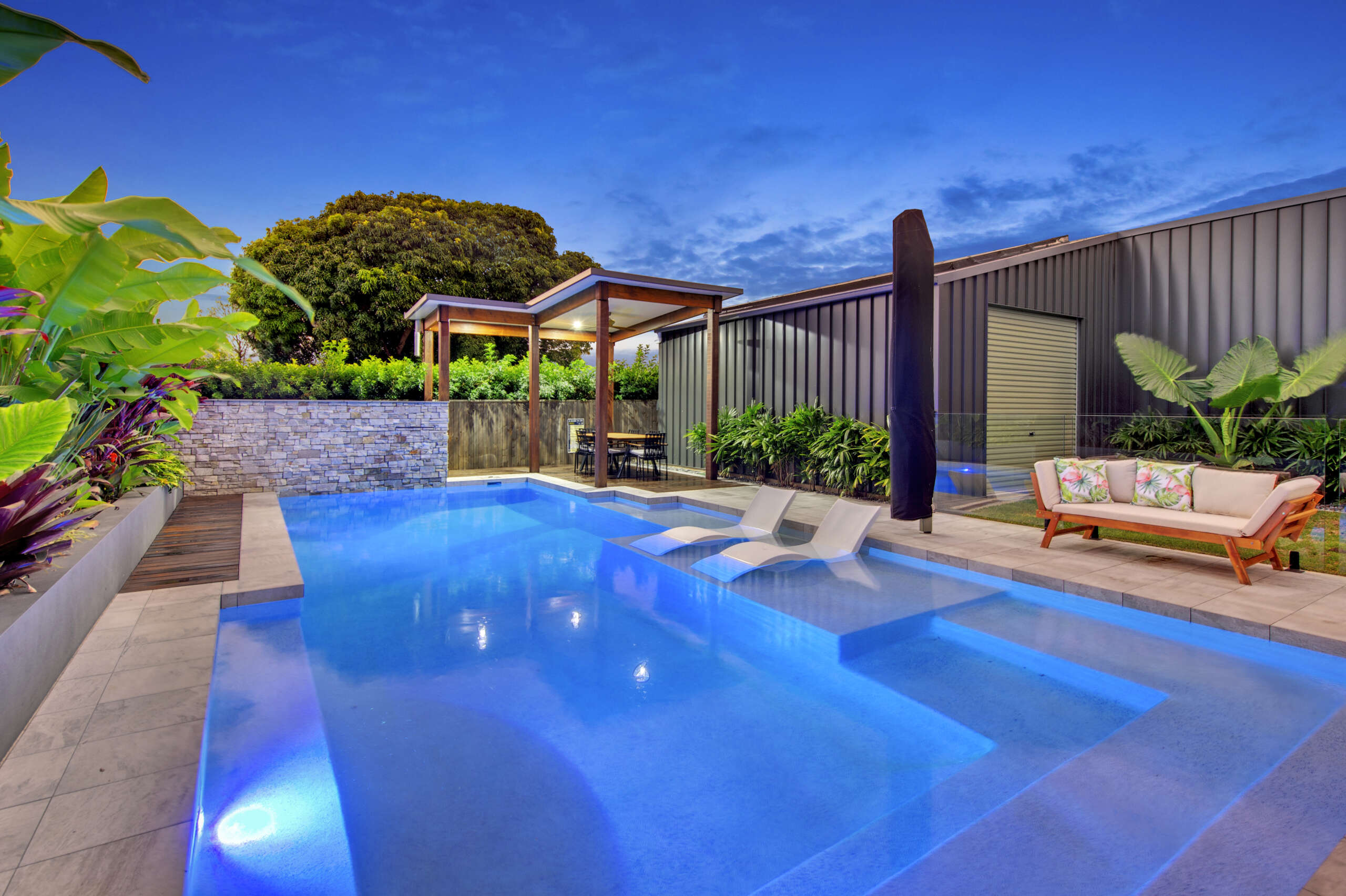
Luxury pools in bayside settings have an obvious design opportunity in the coastal aesthetic. The visual language of the coastal environment – light, reflective water, clean lines, connection to the open sky – translates naturally into pool design. Infinity pools work beautifully in bayside properties with bay or water views, creating a visual continuation between pool water and the broader seascape. Pool lighting choices that lean into blue-white tones complement the coastal palette and extend the usability of the outdoor space well into the evening. This luxury pool in Manly takes full advantage of the space.
Family pools in bayside suburbs should also account for the sun exposure these areas receive. Tanning ledges, shallow-entry zones and integrated shade elements all make practical sense in a high-UV coastal environment where families use the pool heavily through the long summer season.
The Principles That Apply Across All Brisbane Microclimates
Despite their differences, Brisbane’s microclimates share some universal design principles worth carrying across any project.
Solar orientation matters everywhere. Positioning your pool and outdoor entertaining area to capture north-easterly orientation maximises sun access through winter and makes the space genuinely comfortable twelve months of the year. Brisbane winters are mild, but a poorly oriented pool area that sits in shade through June and July loses a significant part of its year-round appeal.
Brisbane’s storm season demands drainage planning. Whether you’re in the hills, the river corridor or bayside, November through March brings heavy, rapid rainfall. Pool surrounds need adequate falls and drainage to clear water quickly, and the pool itself needs an overflow strategy for significant rain events.
Saltwater chlorination with smart monitoring is well-suited to Queensland conditions regardless of your suburb. The combination of saltwater sanitation and real-time chemical monitoring through a system like DHMO reduces the maintenance burden considerably, and in a climate where chemical demands shift rapidly with temperature and rainfall events, automated alerts make a meaningful practical difference.
Material selection should always account for the local environment. What works in a mild, sheltered location won’t necessarily perform in a salt air or high-humidity context. This is an area where local experience and specifically Brisbane pool construction knowledge is genuinely valuable.
Working with What Your Site Gives You
The best pool and outdoor designs in Brisbane work with the specific character of the site rather than imposing a generic solution onto it. A hill site with a western view becomes a canvas for something spectacular with the right infinity pool design. A compact inner-city block becomes genuinely functional with a thoughtfully designed lap pool or pool spa combination. A bayside property becomes a genuine lifestyle asset when the pool design reflects the coastal environment it’s part of.
Environ Pools has been designing and building concrete pools across Brisbane’s full range of sites and suburbs for over three decades. Our design process starts with the specific conditions of your site – topography, orientation, microclimate, access and lifestyle – before any design decisions are made. If you’d like to see what’s possible for your property, browse our pool portfolio or contact us to start a conversation.